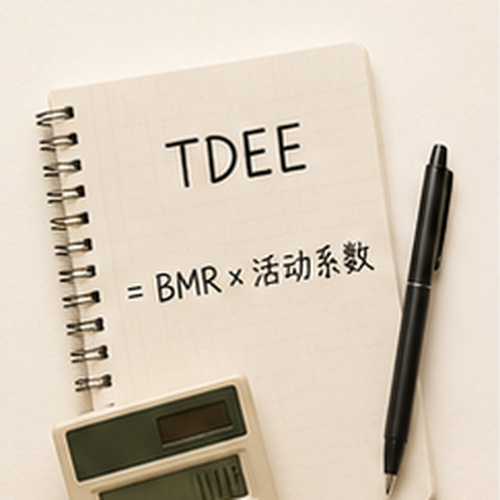
Total daily energy expenditure, or TDEE, is the energy the body uses in a full day to stay alive, move through ordinary tasks, train, and digest food. It is commonly used as a starting estimate for maintenance calories. The calculation has two parts: estimate basal metabolic rate, or BMR, and multiply it by an activity factor that reflects normal life. Most large errors come from choosing the wrong formula, overstating activity, or treating one estimate as a permanent exact number.
A useful TDEE estimate requires age, sex, height, weight, and activity level. Someone with a dependable body-fat estimate can also use the lean-mass-based Katch-McArdle equation. The result can guide an initial calorie target, but it should later be checked against two to four weeks of average body weight, step count, training performance, and hunger.
The TDEE formula
The basic relationship is TDEE = BMR × activity factor. BMR represents the energy needed at rest for breathing, circulation, temperature control, and organ function. The activity factor adds an estimate for walking, work, household tasks, and planned exercise.
The equations below use kilograms for weight, centimeters for height, and completed years for age. Imperial measurements should be converted first: one pound is about 0.4536 kilograms, and one inch equals 2.54 centimeters.
Step 1: choose a BMR equation
Mifflin-St Jeor
Mifflin-St Jeor is a practical default for many adults. Men: BMR = 10 × weight + 6.25 × height − 5 × age + 5. Women: BMR = 10 × weight + 6.25 × height − 5 × age − 161. It is usually the first choice when no reliable body-fat measurement is available.
Revised Harris-Benedict
Men: BMR = 13.397 × weight + 4.799 × height − 5.677 × age + 88.362. Women: BMR = 9.247 × weight + 3.098 × height − 4.330 × age + 447.593. This is another established estimate, and it may produce a somewhat different result from Mifflin-St Jeor.
Katch-McArdle
When body-fat percentage is known, lean body mass is weight × (1 − body-fat percentage). The equation is BMR = 370 + 21.6 × lean body mass. A more detailed equation is not automatically more accurate when the body-fat measurement itself is uncertain.
Step 2: choose an activity factor
An activity factor should describe the whole week, not only the hours spent in a gym. Sitting at work, commuting, daily steps, household labor, a physical occupation, and training frequency all matter. The calculator uses seven levels:
| Activity level | Factor | Typical situation |
|---|---|---|
| BMR only | 1.0 | View resting BMR without added activity |
| Sedentary | 1.2 | Little exercise and mostly seated days |
| Light | 1.375 | Light exercise one to three times per week |
| Moderate-light | 1.465 | Exercise three to five times per week at lower intensity |
| Moderate | 1.55 | Regular exercise four to five times per week |
| Very active | 1.725 | Daily training or frequent hard exercise |
| Extra active | 1.9 | Frequent intense training or a demanding physical job |
Three workouts per week do not automatically make a person moderately active. When the remaining hours are sedentary and daily steps are low, the light category may be closer. A physical worker may have a high daily expenditure even without formal workouts.
For automatic unit conversion and equation selection, enter the same information in the TDEE calculator. The result is an initial estimate and should still be compared with real weight trends.
Worked example 1: TDEE for a woman
Consider a 30-year-old woman who weighs 60 kilograms, is 165 centimeters tall, and exercises regularly four or five times per week. She selects Mifflin-St Jeor and the moderate factor of 1.55.
BMR = 10 × 60 + 6.25 × 165 − 5 × 30 − 161 = 1,320.25 calories. TDEE = 1,320.25 × 1.55 = 2,046.39 calories, or about 2,046 calories per day.
This is an estimate of maintenance calories under the stated conditions. It does not mean that intake must equal exactly 2,046 calories every day. If average intake stays near that amount for several weeks and average weight is stable, the estimate is reasonably close. A continuing loss or gain suggests an adjustment is needed.
Worked example 2: TDEE for a man
Consider a 35-year-old man who weighs 80 kilograms, is 180 centimeters tall, and completes light training one to three times per week. He chooses Mifflin-St Jeor and the light factor of 1.375.
BMR = 10 × 80 + 6.25 × 180 − 5 × 35 + 5 = 1,755 calories. TDEE = 1,755 × 1.375 = 2,413.13 calories, or about 2,413 calories per day.
If he also walks many kilometers each day or works in a physical job, 1.375 may be too low. If the workouts are short and most of the day is spent sitting, raising the factor to 1.55 would probably overestimate expenditure.
How to interpret the result
TDEE works best as a starting maintenance target. Intake can begin near the estimate for weight maintenance, below it for a moderate fat-loss deficit, or above it for gradual weight gain. The appropriate change depends on body size, health, training experience, and whether the plan can be sustained.
A calculator cannot know how many steps were taken today, whether a workout was canceled, how sleep changed, or how an individual metabolism differs from the statistical average. One day of scale movement is therefore a poor reason to change calories. Water, sodium, carbohydrate stores, and food still being digested all move body weight.
Weekly average weight measured under similar conditions is more useful. Daily measurements taken at roughly the same time can be averaged and compared over two to four weeks, reducing the influence of ordinary fluctuations.
Common calculation mistakes
- Using BMR as TDEE: BMR covers essential resting functions and is not the same as full-day maintenance calories.
- Overstating activity: counting workouts while ignoring sitting time and low step counts often produces an estimate that is too high.
- Double-counting exercise: choosing an active multiplier and then eating back every calorie shown by a watch may count the same activity twice.
- Entering the wrong units: pounds in a kilogram field or inches in a centimeter field will make the result unusable.
- Never recalculating: a major change in weight, work, steps, or training means the old estimate no longer describes current life.
Calibrate TDEE with real data
Begin with the estimate and keep food intake, steps, and training reasonably consistent. Record at least two weeks, or four weeks when short-term water changes are large. Compare average weights instead of selecting the highest or lowest day.
A stable average suggests that recorded intake is close to maintenance. A slow decline means average intake is below actual TDEE, while a slow rise means intake is above it. Food-recording errors, weekend meals, and drinks should be considered before blaming the equation.
When an adjustment is needed, a small daily change is easier to evaluate than a large immediate cut or increase. Hold the new target long enough to observe a trend instead of changing it repeatedly within a few days.
TDEE is not a permanent personal constant. Weight loss, fewer daily steps, a different training phase, or a new job can change total expenditure. Recalculate when circumstances change, then check the new estimate against real results.
Frequently asked questions
What is the difference between TDEE and BMR?
BMR is the energy required to maintain life at rest. TDEE starts with BMR and adds daily movement, exercise, and the thermic effect of food, making it closer to total daily expenditure.
Should I choose a higher or lower activity factor?
When uncertain, begin with the more conservative level and adjust from two to four weeks of weight data. Overestimating activity is often harder to notice than a modest underestimate.
Can I add the calories from my fitness watch to TDEE?
The activity multiplier already includes some exercise. Adding every calorie reported by a watch may double-count it. Wearable data is better for comparing relative changes than for treating each calorie as exact.
How often should TDEE be recalculated?
Recalculate after roughly a five-percent weight change, a large training change, a move to work with very different physical demands, or several weeks in which the target no longer matches the weight trend.
Conclusion
Calculating TDEE has two central steps: estimate BMR with appropriate data and an appropriate equation, then select an activity factor that describes the entire week. The equation provides a reasonable starting point; consistent records provide the personal evidence.
Correct units, a conservative activity choice, and two to four weeks of average weight are usually more useful than a calorie target that looks precise to the last digit.